The ESPIRE Program consists of three phases with a potential financing envelope of up to $500 million that seeks to improve Georgia’s institutional capacity for the development of submarine cable projects, strengthen Georgia’s domestic power transmission system, and establish a direct electricity interconnection between the South Caucasus and Southeast Europe. Additionally, the parallel digital interconnection would reduce internet connection costs, improve bandwidth, and generally enhance international digital connectivity across the Black Sea.
The ESPIRE Program is designed to support the next steps in the preparation of a potential Black Sea Submarine Cable (BSSC) Project,which aims to establish parallel electricity and fiber-optic submarine cable interconnections across the Black Sea of Ukraine, with landing points in Georgia and Romania.
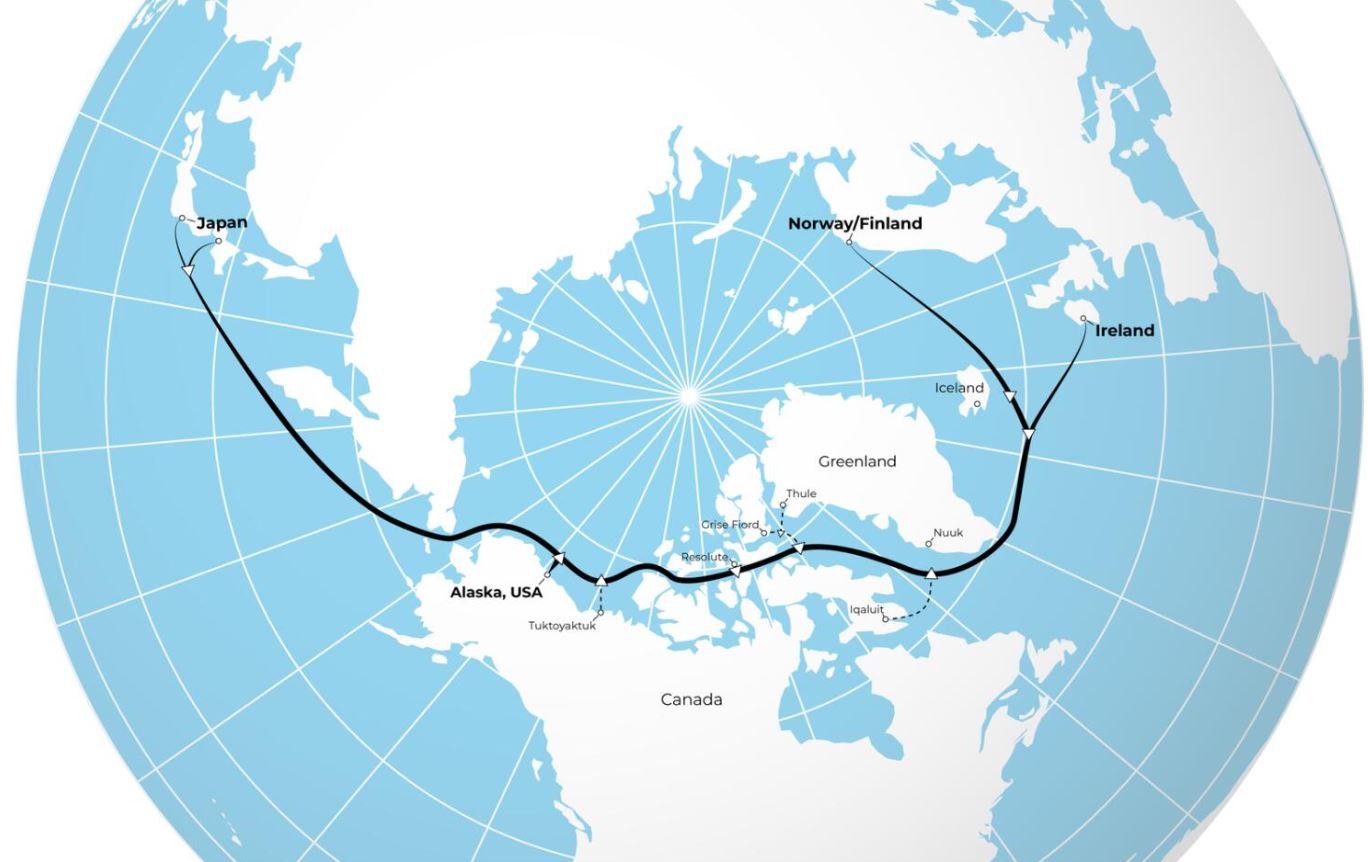
The Irish government has backed the project which was rerouted after Russia invaded Ukraine. The Far North Fiber project cable would connect Europe directly to Asia and allow massive data transfers at speed, connecting major data centre hubs in Ireland to Asia.
The Irish government has backed plans for a new €1.1 billion fibre optic subsea cable connecting Galway and Norway to Japan through the Arctic Circle.
The Far North Fiber project will run a 15,000 kilometre route from the Norwegian coast to Greenland, with a line splitting off into Galway, before hugging the Canadian Arctic coast and passing by Alaska into the Pacific Ocean and on to Japan.
The cable would connect Europe directly to Asia and allow massive data transfers at speed, connecting major data centre hubs in Ireland to Asia.
The project was originally conceived by the Finnish company Cinia, with the initial route plotted in 2018 to run along the Russian coast.
The invasion of Ukraine and rising geopolitical tensions saw the project change course, and switch to the opposite side of the Arctic circle for its primary route.
It is now being spearheaded by a consortium of companies, including Cinia, Arteria Networks, a Japanese company, Far North Digital, an Alaskan company, and Alcatel Submarine Networks, an international cable supply chain company.
Ossian Smyth, junior minister at the department of communications, said when the planned route changed, he approached the Finnish government to say Ireland would like to be involved.
“I told the Finns I would be very keen to get the connection in to Ireland too, and Galway bay was the ideal landing spot,” Smyth told the Business Post.
Smyth said he met with LuLu Ranne, the Finnish communications minister, last week and that she welcomed Ireland’s involvement. Ranne is meeting the Japanese communications minister on Monday to discuss the project.
Galway recently landed a subsea fibre optic cable from Iceland, and is increasingly seen as a high potential area for future projects.
“Certain data centres may find Galway a more attractive place as a result,” Smyth said.
Smyth said that the Irish government would consider investing in the project, but first it had to establish its broader policy in relation to subsea cables.
He said a new paper on whether Ireland will subsidise or take a more active interest in future subsea cable projects will be published later this month.
Regardless of whether the Irish government decides to invest in Far North Fiber, Smyth said he would be pushing for significant European funding for the project, which is expected to cost over €1 billion.
“We want Europe to support this. Both through the Projects of Common Interest and the Connecting Europe facility. But we also think they should go further, and take a much greater strategic interest in these cables,” he said.
The Arctic Circle is an increasingly important geographic region, where a number of world superpowers have territory facing in on one another. As climate change is causing ice to retreat for longer periods every year, routes for trade, mineral and fossil fuel exploration, and even military activity are increasing.
Ireland applied to become an observer member of the Arctic Council, the international body diplomatic body for the region, in 2021, but was rejected.
154 communities along the entire British Columbia Coast to get access to new or faster Internet through $45-million investment
Through a combined investment of $45.4 million, the Government of Canada in partnership with the Government of British Columbia is bringing new or improved high-speed Internet to 154 rural and remote communities, enabling residents to get online. Of these 154 communities, 44 First Nations will benefit.
The funding was announced by the Honourable Jane Philpott, Minister of Indigenous Services, on behalf of the Honourable Navdeep Bains, Minister of Innovation, Science and Economic Development; the Honourable Jinny Sims, British Columbia Minister for Citizens’ Services; and Jennifer Rice, British Columbia Parliamentary Secretary for Emergency Preparedness and Member of the Legislative Assembly for the North Coast, at Canada Place in Vancouver.
This investment will help residents of these communities connect with family and friends, do business online, participate in distance education and take advantage of the opportunities afforded by the digital age. It will also help connect schools, hospitals, libraries and businesses to networks that are essential to their services.
Today’s investment includes new subsea fibre optic cable that will connect communities between Prince Rupert and Vancouver, as well as around Vancouver Island—a total of 3.5 million metres of cable. Thanks to this investment in high-capacity networks in remote and underserved communities, all British Columbians, including First Nations, will be able to fully participate in the digital economy.
The Connected Coast project will bring high-speed internet to approximately 139 rural and remote communities, including 48 First Nations communities, along the B.C. coast from north of Prince Rupert to Haida Gwaii, south to Vancouver, and to Vancouver Island.
Construction of the $45.4 million project is approximately 60%complete with close to 1,100 kilometers of fiber-optic cable laid.
We are excited to share that there has been lots of progress!
Permitting is now underway for the entire west coast of Vancouver Island
• Cable lay and construction will be occurring between Campbell River and Port Hardy this month
• Fibre optic Link to Haida Gwaii is in final stages of commissioning and handover from our design builder
• Network testing is ongoing along other portions of the network, stay tuned for further updates of our commissioning and handover activities
Communities with completed last mile build infrastructure will soon experience high-speed internet connectivity.
NEW INTERACTIVE BUILD STATUS MAP
A NEW interactive map can now be viewed online. Users can follow along and see the current build status on specific locations, search the status of specific landing sites, and zoom in for more details.